
Mobile County Released Inmates
A released Mobile County inmate is a person whose jail, prison, or detention custody has ended or moved out of the source being checked. For a county jail case, that usually means the person leaves the Mobile County Sheriff's Office current roster. The roster can show who is in custody at Mobile County Metro Jail, but it is not a long release archive. The record that proves the exit is the jail-book or booking and release entry, the court order that caused the release, a VINE custody-change notice, or another agency record if the person was transferred.
Release has several meanings in Mobile County. A person can bond out while the case remains open, finish a short jail sentence, receive time served, be dismissed by the court, move to probation, transfer to the Alabama Department of Corrections, enter parole or mandatory supervision, move to federal custody, or be held on an immigration detainer. Each path leaves a different public trail. That is why a missing name on MCSO Who's in Jail is only a clue. The next step is to verify the release date, release authority, and custody path through the source that owns the record.
Mobile County Release Types
The release type tells a reader where to look next. A bond release is not the same as a sentence discharge. A state-prison transfer is not the same as release to the community. Mobile County Metro Jail serves county and City of Mobile cases, and older MCSO handbook material also described federal and state transfer populations. The table below keeps those paths separate so the search does not stop at the first missing roster entry.
| Release or exit type | What it means | Where it shows next |
|---|---|---|
| Bond or court release | The person leaves jail while the case may still be pending. | Mobile County District or Circuit Criminal docket, City of Mobile Municipal Court, and MCSO release record. |
| Time served or sentence end | A county jail term is complete or the court credits jail time. | Jail-book release date and the sentencing or disposition entry. |
| Probation | The court places the person under supervision instead of, or after, custody. | Court docket and Alabama Bureau of Pardons and Paroles local office when applicable. |
| ADOC transfer or discharge | The person is sent to or released from Alabama state custody. | ADOC Inmate Search, ADOC records, and ABPP status if supervision follows. |
| Federal or ICE transfer | The person leaves county custody for another federal custody path. | BOP Inmate Locator, federal court, USMS, or ICE ODLS. |
Mobile County Release Record Fields
Alabama sheriff records matter because the web roster may not keep released people visible. The Alabama sheriffs' handbook describes the public prisoner record required under Alabama Code Section 36-22-8. It says the record includes the prisoner's name, physical description, reason held, authority for confinement, confinement date, and release date. For Mobile County released inmates, those fields are the backbone of the release record even when the public web pages only show current custody or recent booking activity.
| Field | What it shows |
|---|---|
| Name and identifying details | Links the jail entry to the correct person and helps separate similar names. |
| Reason held or charge | Shows the charge, warrant, sentence, or authority tied to the custody event. |
| Authority for confinement | Identifies the court, agency, or legal process that placed the person in custody. |
| Confinement or booking date | Marks the start of the custody period for that jail entry. |
| Release date | Confirms when the person left that custody source. |
| Release reason or transfer note | May explain bond, time served, transfer, court order, ADOC, federal, or ICE movement if public. |
Q: Does a missing roster name prove a person is free? A: No. It can mean release, transfer, data refresh, another hold, or a record change. Confirm the release date and release authority before treating the person as released to the community.
Obtain Mobile County Release Records
The Mobile County Sheriff's Office records fallback is Civil Division and Central Records. MCSO says it is best to make a records request by completing the Open Records Act request form and following the form instructions. The form asks for a specific description of the record, subject, date or time frame, people involved, case number, location, county or city, and why MCSO is believed to hold the record.
- Identify the custody source. For Mobile County Metro Jail or the barracks, request the MCSO jail-book or booking and release entry.
- Give exact identifiers. Include full name, date of birth if known, booking date, booking number, charge, arresting agency, and court case number if available.
- Ask for the fields needed. Use purpose-neutral wording such as release date, release type or reason, authority for confinement, transfer note, and booking photograph if needed.
- Use court records in parallel. Bond, dismissal, sentence, probation, split sentence, revocation, and time-served entries often explain why the jail released the person.
- Use ADOC or federal records when the person left county custody for another system.
Request the exact booking and release entry, not a broad list of all released inmates, because precise requests are easier for the records office to process.
Alabama public-records law also matters. Alabama Code Title 36, Chapter 12, Article 3 supplies the baseline right to inspect and copy public writings, subject to exceptions. Section 36-12-41 addresses copies and a reasonable fee. Sealed, juvenile, Youthful Offender, expunged, medical, victim, active-investigation, and security records may be withheld or redacted. ALEA states that Alabama Code Section 15-27 allows expungement in certain cases and that courts grant expungements, not ALEA.
Mobile Bond Release Checks
Bond-out releases are a common source of confusion in Mobile County because the person may leave Metro Jail while the case remains active. The jail roster can stop showing the person, but the release order, bond entry, or next court setting may sit in the court record. District Criminal and Circuit Criminal records are therefore part of the release check, not a separate task.
Use Mobile County District Criminal for district criminal matters and Mobile County Circuit Criminal for felony and higher-level criminal records. AlaCourt Access also offers on-demand Alabama trial court records. For City of Mobile charges, use the municipal court record path because a Metro Jail booking may connect to a city case rather than a county felony file.
Note: A bond release can leave custody fast, but the court case can keep moving after the jail record closes.
Find Released Mobile County Inmates
The best search path starts with the custody type. For a recent Mobile County Metro Jail booking, use the current roster and recent booking page to confirm whether the person is still held or recently entered the jail. If the person is not listed, do not treat that as the final answer. Move to court records, VINE, MCSO records, and any state, federal, or ICE system that fits the case.
- Check Who's in Jail to see whether the person is still in Mobile County custody.
- Check 24-Hour Booking for recent intake, booking date, spelling, and charge context. This is a booking feed, not a release list.
- Search the court docket through AlaCourt, District Criminal, Circuit Criminal, or City of Mobile Municipal Court for the order or disposition that explains the release.
- Use VINE Inmate Check for a one-person custody-status alert when the custody stream participates.
- Use ADOC, BOP, or ICE only when the facts point to state prison, federal custody, or immigration detention.
- Request the MCSO release record if the online sources do not show the release date or reason.
ADOC Search for Mobile Releases
ADOC Inmate Search is the Alabama state-prison search path. It is not the first stop for every Mobile County jail booking. Use it when the person was sentenced to ADOC, transferred from Metro Jail to state custody, housed at Mobile Community Based Facility and Community Work Center, or had a state-prison release or parole status question. ADOC says the AIS number is a unique six-digit number and is the fastest way to find a specific inmate. If AIS is entered, it controls the search and the name fields are ignored.
The ADOC offender search and ADOC definitions page are useful because Alabama uses terms such as Minimum Release Date, Parole Consideration Date, and Parole Status. The minimum release date is the earliest scheduled date an inmate can be released to probation or end of sentence, but ADOC says it can change because of disciplinaries that take away good time, new cases, or sentence changes from the circuit clerk.
| Search field or status | How it helps |
|---|---|
| AIS number | Searches the exact Alabama inmate record when the six-digit number is known. |
| First and last name | Useful when AIS is unknown, but spelling and aliases can affect matches. |
| Minimum Release Date | Shows the earliest scheduled release to probation or end of sentence, not a guaranteed walk-out date. |
| Parole Consideration Date | Shows a tentative board-review date, not a release date. |
| Parole Status | May show whether the person is on parole, delinquent, or revoked. |
The ADOC search screen is shown on the official Alabama Department of Corrections inmate search page.
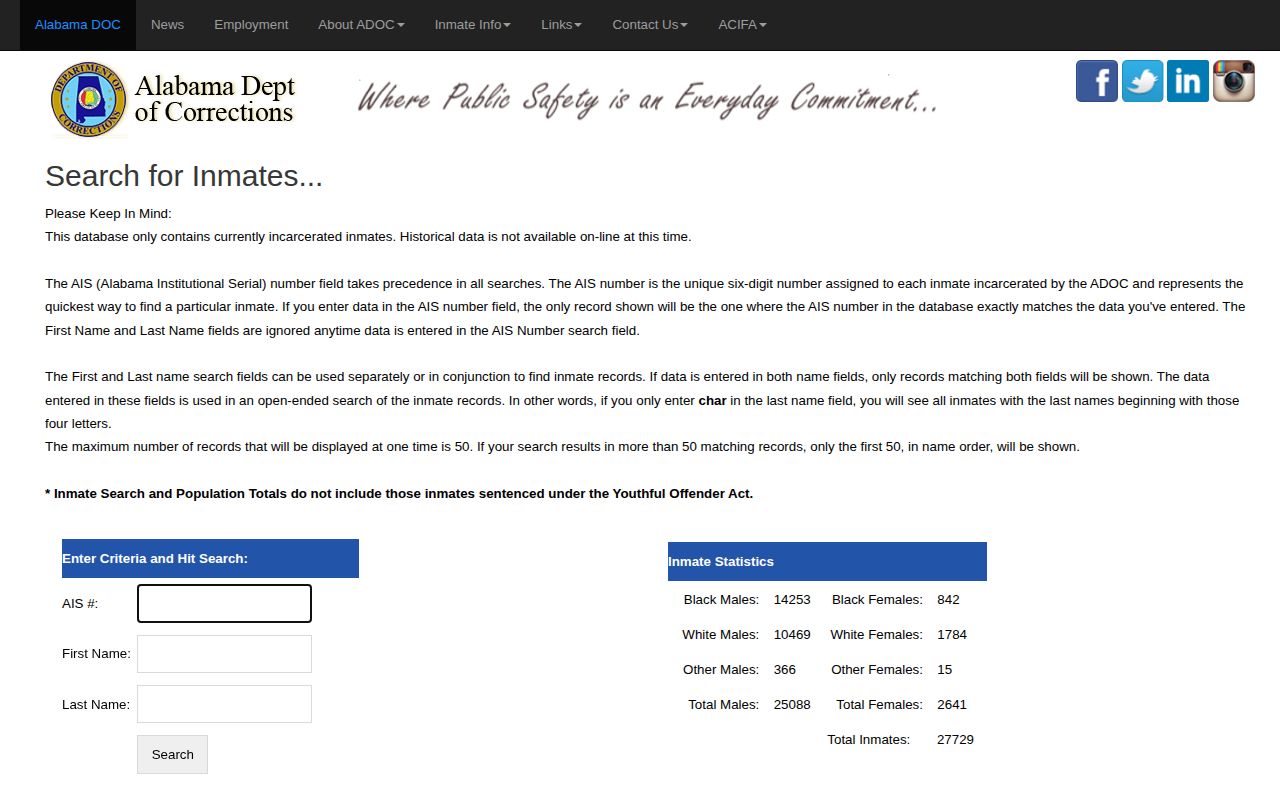
Use the screenshot as a cue for which state fields are relevant, then confirm any release date through ADOC status, ABPP supervision, VINE, or a records request when the answer must be exact.
Mobile County Recent Releases
Mobile County's official web structure emphasizes current custody and booking. The located MCSO pages include Who's in Jail and 24-Hour Booking. The access sweep did not locate a distinct official 24-hour release, 72-hour release, or recent-release archive. That local fact should shape any search for Mobile County released inmates. The 24-Hour Booking page can help identify a recent intake and charge, but the release confirmation still comes from the jail-book record, court entry, VINE, or agency contact.
The official MCSO 24-Hour Booking page is still useful because it can narrow the booking date and name spelling before a records request.
For same-day jail activity, use the 24-Hour Releases page for the local no-release-feed workflow, and use the home search path here when one named person must be verified across systems.
Mobile Post-Release Supervision
Post-release supervision in Mobile County is mainly an Alabama Bureau of Pardons and Paroles issue. The local ABPP Mobile Field Office serves Mobile County, while ADOC status fields and parole-hearing pages help explain whether a state prisoner reached parole, mandatory supervision, probation, or discharge. Mobile also has an ADOC community based facility and work center, so a person can be in minimum-community or minimum-out custody before a full release.
Parole means the Board released a state prisoner under conditions. Probation is court-ordered supervision that may replace or follow jail time. Mandatory supervision is a statutory state release path supervised by ABPP. A discharge means the custody or supervision term ended, though a separate court order or registry duty can still matter. The Post-Release Supervision page covers the local field office and verification steps in more detail.
- Parole
- Conditional release from prison under the parole board's authority.
- Probation
- Court-ordered supervision in the community.
- Discharge
- End of a sentence, custody term, or supervision period.
- Detainer
- A hold from another agency that can change where the person goes after jail.
Mobile VINE and Federal Checks
VINELink Alabama and the Alabama Victim Notification System are custody-status and notification channels. They are not a complete archive of every Mobile County release, but they can help with one-person checks and custody-change alerts when a participating jail or prison feed covers the person. The Alabama notification site lists a state help contact, and VINELink offers search and registration workflows for covered custody events.
Federal and immigration paths are separate. BOP says its locator includes federal inmate records from 1982 forward and can show Released or Not in BOP custody with a release date. ICE says ODLS locates people currently in ICE custody or in CBP custody for more than 48 hours. If a person disappears from the Mobile roster after a federal or ICE hold, those systems are transfer and continued-custody checks, not Mobile County release archives.
Released or Still Held
One system rarely answers every Mobile County release question. A current roster can show custody. A court docket can show the order or sentence. A jail-book record can show release date. ADOC can show a state-prison status. BOP can show a federal release. ICE can show current immigration detention. The comparison below keeps those sources in their lane.
| Question | Best source | Key limit |
|---|---|---|
| Is the person still at Metro Jail? | MCSO Who's in Jail | Current-custody focus, not a full release archive. |
| Was there a recent booking? | MCSO 24-Hour Booking | Booking feed, not an official release feed. |
| What caused the release? | District, Circuit, municipal, or AlaCourt records | May require paid access or clerk copies. |
| What is the jail release date? | MCSO jail-book or booking/release record | Usually requires a specific records request when not online. |
| Was it an ADOC release? | ADOC search and records | Does not cover most county-only releases. |
| Was it federal or ICE? | BOP locator, federal court, USMS, or ICE ODLS | Does not prove a Mobile County jail release to the community. |
Mobile Release Logistics
Local release details can matter after the record search. MCSO handbook material notes a narrow commissary issue: if an inmate is released before commissary delivery, the person has five working days beginning the day after delivery to pick up the package from the Money Clerk's office during normal business hours. Treat that as a specific commissary pickup rule, not a broad claim about all property.
Mobile's county and city court split also affects release checks. Metro Jail serves county and City of Mobile custody, while City of Mobile Municipal Court has its own case and docket path. A release tied to a municipal charge may be explained in the city court record, not in a county felony file. Federal and immigration transfer caveats add one more layer: leaving the roster can mean movement to ADOC, USMS, BOP, ICE, or another authority.
Q: What if the person vanished from the roster after an ICE hold? A: Use the jail record to confirm the county exit, then check ICE ODLS only as a current immigration-custody locator.
Mobile County Release Facilities
The Mobile County facility map includes county jail, minimum-security barracks, a state community work center, court paths, federal custody, ICE, and registry lookups. The main jail and barracks are MCSO release-record paths. The ADOC work center is a state offender-search and ADOC records path. Court pages explain the order, sentence, bond, or disposition. Federal, ICE, and registry pages apply only when that specific custody or registration path is relevant.
- Mobile County Metro Jail
- Mobile Metro Barracks / minimum-security barracks
- Mobile Community Based Facility and Community Work Center
- Mobile Municipal Court / City of Mobile custody pipeline
- Thirteenth Judicial Circuit / Mobile County District and Circuit Courts
- Federal custody path serving Mobile County
- ICE / immigration detention locator path
- Alabama sex-offender registry / Mobile County OffenderWatch
Public Record Search
Sponsored Results