
Mobile Projected Release Date
The phrase "projected release date" is common, but Alabama's ADOC public terminology is more specific. ADOC uses "Minimum Release Date" for the earliest scheduled date an inmate can be released to probation or end of sentence. That field is a state-prison field. It is not the same as a Mobile County Metro Jail bond date, a municipal court release order, or a county jail sentence ending date.
A projected date is not the same as actual release. Actual release is confirmed after the custody event happens, through ADOC status, MCSO jail-book release fields, a court order, a VINE alert, or an agency records response. A scheduled date can move. A person can also leave one custody system and enter another, such as ADOC, federal custody, ICE custody, or supervision.
Scheduled vs actual: A minimum release date is the earliest scheduled state-prison date. The actual Mobile County release record confirms what happened and why.
For a Mobile County jail detainee awaiting trial, there may be no date to calculate. Release may occur when bond is posted, a judge orders release, a charge is dismissed, a sentence is served, a hold is cleared, or another agency takes custody. That is why the county jail path relies on court and sheriff records rather than ADOC's minimum release field.
ADOC Minimum Release Date
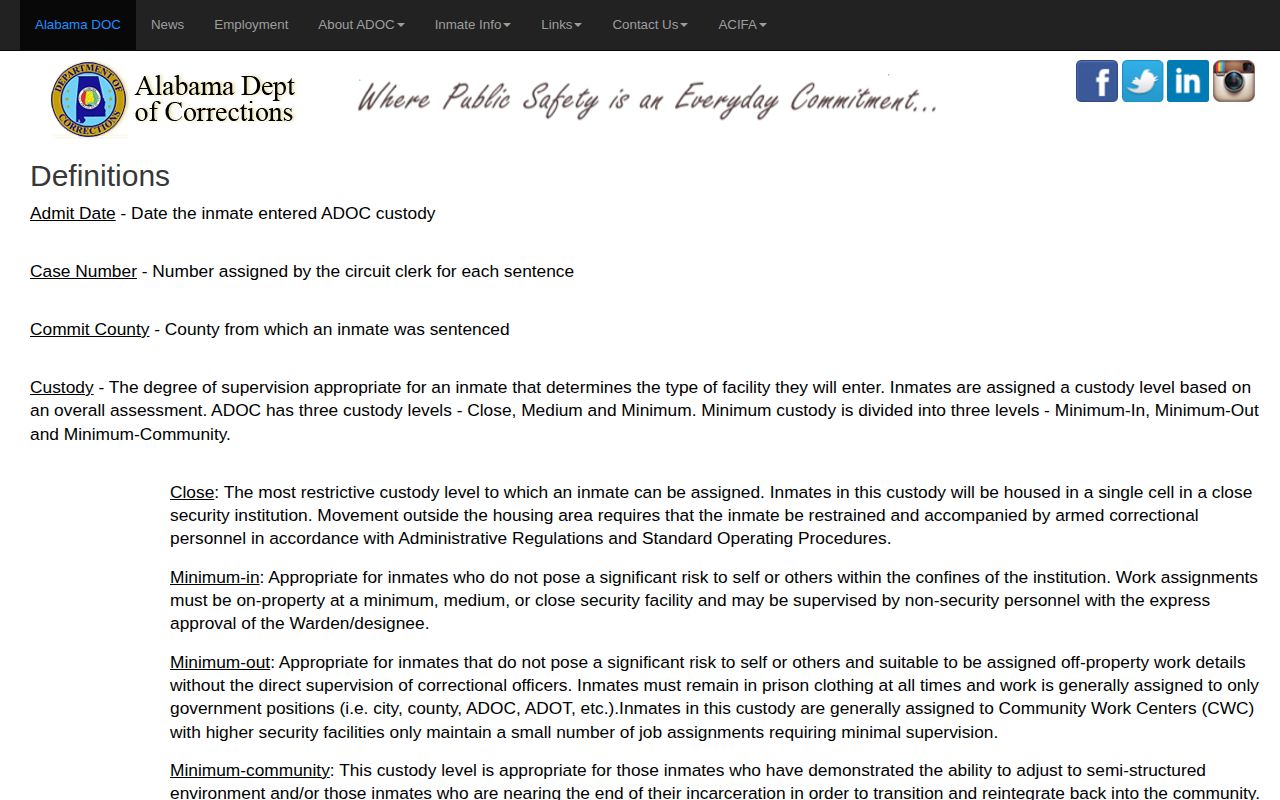
The ADOC Definitions page is the central source for the Mobile County release date lookup when a person is in state custody. ADOC defines minimum release date as the earliest scheduled date an inmate can be released to probation or end of sentence. ADOC also says the date can change if an inmate receives disciplinaries that take away good time or if the circuit clerk sends new cases or changes the current sentence.
That definition is the key computation rule for a Mobile County sentence that moved into ADOC custody. The person may have started in Mobile County Metro Jail, then been sentenced in Mobile County Circuit Court, then transferred to ADOC or the Mobile Community Based Facility and Community Work Center. Once the person is an ADOC inmate, ADOC records become the public release-date source.
The ADOC Definitions page explains the minimum release date, parole consideration date, and parole status fields used for Alabama state inmates.
Lookup a Mobile Release Date
Start by deciding whether the person is county jail, state prison, parole, federal, immigration, or court-supervised. A single search box will not answer all of those. The release date is held by the agency that controlled the custody or sentence at the time of the release event.
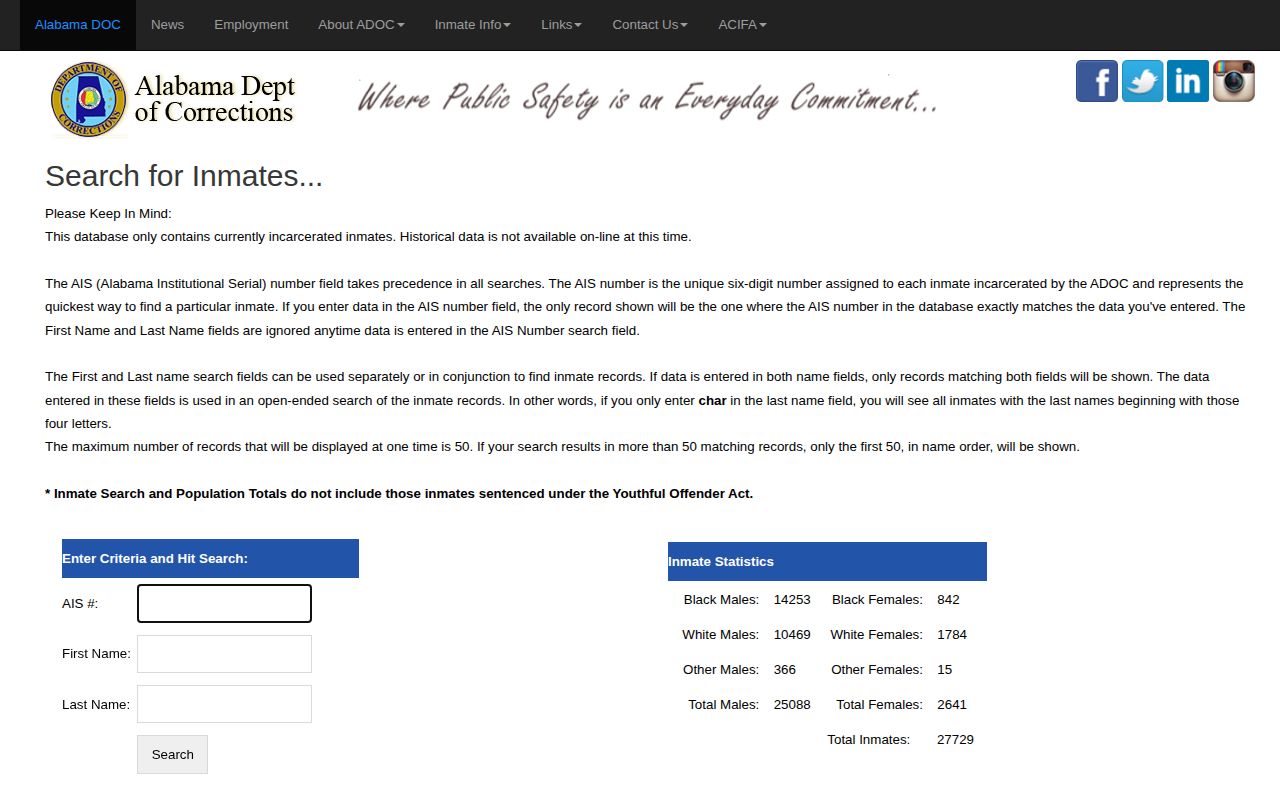
- For a sentenced state prisoner, search the ADOC Inmate Search by AIS number if known, then by name.
- Read the ADOC minimum release date, parole consideration date, parole status, and location fields separately.
- For a Mobile County Metro Jail detainee, check MCSO roster or booking context, then use MCSO records for the jail-book release entry.
- For bond, dismissal, sentence, probation, split sentence, or revocation, use Mobile County District or Circuit Court records.
- Register through VINE inmate check when a custody-change alert is needed.
- For federal custody, use BOP. For immigration custody, use ICE ODLS.
The broader Mobile County released inmates workflow helps when the starting point is only a missing roster entry. A missing roster entry is a clue, not a release date.
The ADOC Inmate Search is the state-prison release date source when the person has an Alabama state inmate record.
Alabama Good-Time Rules
Alabama correctional incentive time is governed by Alabama Code Section 14-9-41. The statute creates earning classes and exclusions. Research found no support for a simple blanket rule that every Alabama inmate serves one fixed percentage. The release calculation depends on the sentence, offense type, classification, incentive-time eligibility, disciplinary record, court updates, parole process, and statutory exclusions.
Some prisoners may not receive correctional incentive time. The statute excludes several categories, including certain serious offenses and sentence types. Class IV prisoners receive no correctional incentive time and generally serve flat or day-for-day time. Those rules can affect the ADOC minimum release date because the date is calculated from legal and prison-record inputs.
Mandatory supervision is a related but different state release path. ADOC announced implementation of releases to mandatory supervision under Alabama Code Section 15-22-26.2. A person may leave prison under supervision before final sentence expiration and still be under ABPP supervision. That is a release date question and a post-release supervision question at the same time.
Why Mobile Release Dates Change
Release dates are dynamic because the record is recalculated when the legal or custody inputs change. ADOC's own definition names disciplinary good-time loss and circuit clerk sentence or case changes. Mobile County court records can also create or explain the change, especially when the person has a new case, revised sentence, split sentence, revocation, or corrected jail credit.
| Change | Likely Source | Effect on Date |
|---|---|---|
| Good-time loss | ADOC disciplinary and classification records | Can move the minimum release date later |
| New case or sentence change | Mobile County court and circuit clerk updates | Can recalculate the release date |
| Detainer or hold | County, state, federal, or ICE record | Can block community release or move custody elsewhere |
| Parole decision | ABPP hearing schedule and results | Can lead to supervised release, denial, or later review |
| Mandatory supervision | ADOC and ABPP | Can move the person from prison to supervision before sentence end |
Note: A date change is not always an error. It may reflect a new court record, discipline, or lawful release mechanism.
Mobile Jail Release Dates
County jail releases are different from state-prison release dates. Mobile County's public jail pages are current roster and booking oriented. The research did not locate an official MCSO release-date feed. Alabama's sheriff jail-book statute fills that gap because the public prisoner record includes confinement and release-date fields. For a county jail sentence or pretrial release, request the jail-book or booking and release record from MCSO when the web pages do not show the answer.
Court records are often the reason the release happened. Mobile County District Criminal records may show misdemeanor and preliminary felony case events. Mobile County Circuit Criminal records may show felony sentencing, split sentences, probation, revocation, and commitments to ADOC. City of Mobile Municipal Court records may explain release from a municipal case that still used Metro Jail custody.
| Custody Path | Release-Date Source | What to Ask For |
|---|---|---|
| Metro Jail pretrial case | MCSO records and court docket | Bond, order, release date, release reason |
| County or municipal sentence | MCSO jail-book and sentencing court | Sentence, jail credit, time served, release entry |
| State-prison sentence | ADOC and ABPP | AIS record, minimum release date, supervision status |
| Federal sentence | BOP and federal court | Released or not-in-BOP-custody status and federal docket |
Confirm Actual Mobile Release
Actual release is confirmed after the custody change. For Metro Jail, ask MCSO Civil Division and Central Records for the booking and release entry. For state custody, use ADOC search status and, when needed, ADOC public records. For parole or mandatory supervision, pair ADOC with ABPP. For probation, use the court order and supervision record. For a VINE alert, keep the alert as a notification, then verify the record holder if the reason or copy matters.
Use exact request identifiers where possible: full name, date of birth if known, booking date, booking number, AIS number, case number, charge, arresting agency, and requested fields. For a release date lookup, the useful fields are confinement date, release date, release authority or reason, transfer notation, minimum release date, parole status, and supervision status when public.