
Mobile County Parole and Probation
Parole and probation are not the same as the Mobile County Metro Jail roster. The roster shows current county custody. Post-release supervision describes a legal status after a person has been released from jail or prison, or after a court has placed the person under supervision instead of more confinement. In Alabama, the Alabama Bureau of Pardons and Paroles handles field supervision, while the Alabama Board of Pardons and Paroles handles parole decisions and pardon matters.
A released state prisoner may be on parole, mandatory supervision, probation, or full discharge. Parole means the Board granted release from prison under conditions. Mandatory supervision is a statutory release-to-supervision path handled by ABPP before the end of certain sentences. Probation is usually ordered by a court, either instead of a jail or prison term or as part of a split sentence. Full discharge means the custodial term has ended, though separate court duties, registry duties, or fines may still exist.
| Status | Who Creates It | Where to Verify |
|---|---|---|
| Parole | Alabama Board of Pardons and Paroles | ADOC status fields, ABPP hearing pages, and ABPP Mobile Field Office |
| Probation | Mobile County District or Circuit Court | Court docket, sentencing order, and probation supervision office |
| Mandatory supervision | Alabama statute and ADOC release process | ADOC record, ABPP supervision contact, and VINE notice where available |
| Discharge | Custody agency or court, depending on sentence | Release record, ADOC discharge fields, or court completion record |
- Parole
- Release from prison before full sentence expiration, under Board conditions and field supervision.
- Probation
- A court-ordered supervision term that may follow or replace jail or prison custody.
- Absconder
- A person accused of leaving supervision or failing to report as required.
- Discharge
- The end of a custody or supervision term, when no more supervision remains for that sentence.
Verify Mobile County Supervision
The most reliable verification path depends on whether the person left county jail, state prison, or a court-ordered probation term. A county jail detainee released on bond or time served may never appear in ADOC. A state prisoner released from ADOC, including a person housed at the Mobile Community Based Facility and Community Work Center, is more likely to have ADOC status fields and ABPP supervision records. A person sentenced in Mobile County court may have a probation order or revocation entry in the court file.
- Check the ADOC Inmate Search when the person was sentenced to state prison or transferred from Mobile County to ADOC. Use the AIS number if known.
- Read ADOC status fields carefully. Parole status, parole consideration date, and minimum release date serve different purposes.
- Use scheduled parole hearings and current-year parole results to see whether the Board considered or decided parole.
- For probation, split sentence, revocation, or time-served issues, check Mobile County District or Circuit Court records through the clerk or AlaCourt Access.
- Contact the Mobile Field Office when local ABPP supervision is the specific question and public information is available.
Use Mobile County released inmate search paths when the only known fact is that the person dropped off the jail roster. Roster absence alone does not prove parole, probation, or community release. It may also mean transfer, court update, data correction, or another custody path.
Mobile ABPP Field Office
The local supervision contact for Mobile County is the ABPP Mobile Field Office. It serves Mobile County and gives the page a concrete local source for supervision questions. The office is not a substitute for a court record or ADOC release record, but it is the right local agency contact when the question is whether a released state prisoner is reporting under ABPP supervision.
Alabama Bureau of Pardons and Paroles, Mobile Field Office
1514 South Broad Street
Mobile, AL 36605
Phone: 251-433-0554
Fax: 251-433-6387
Hours: Monday through Friday, 7:00 a.m. to 5:00 p.m.
The ABPP Public Information Unit is the broader agency route for parole eligibility, hearing dates, and hearing results. That matters in Mobile County because Alabama does not provide a simple public parolee search that works like a county roster. The practical chain is ADOC identity and status first, ABPP hearing pages second, and local office contact when supervision details are the issue.
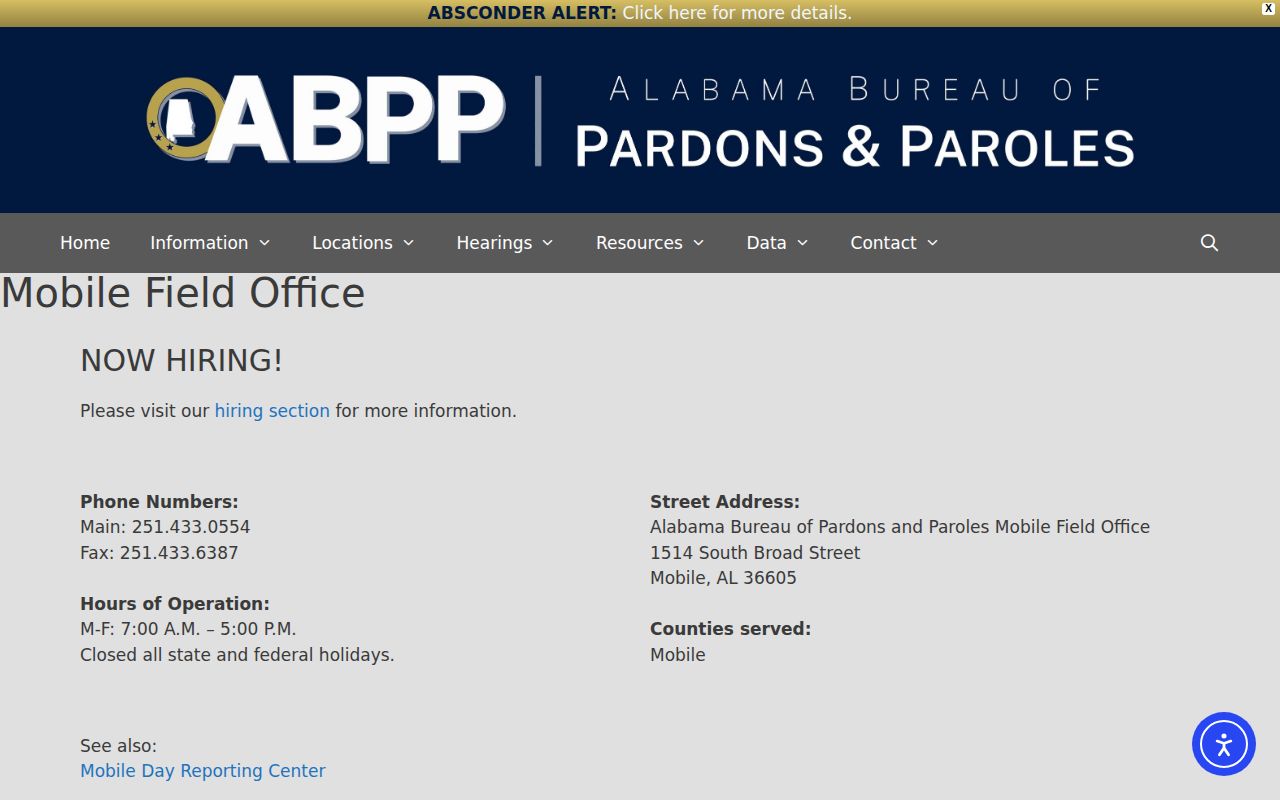
The ABPP Mobile Field Office page identifies the local office used for Mobile County supervision.
Mobile County Parole Hearings
Parole hearing records are a separate piece of the post-release supervision trail. A parole consideration date is not a release date. It is a tentative Board date. The person can be granted parole, denied parole, deferred for future consideration, continued, or affected by a cancellation. That is why an ADOC parole consideration date should be paired with the ABPP hearing schedule and results, not read as proof that release happened.
Alabama Code Section 15-22-28 supplies the parole investigation and consideration framework. ABPP publishes upcoming scheduled parole hearings, current-year results, and older hearing-result posts. Those result posts often summarize grants and denials by date. A grant means release to supervision when the release process is completed. A denial usually means the person remains in ADOC custody unless another lawful release mechanism applies.
For Mobile County post-release supervision, hearing pages help answer one narrow question: did the Board act on parole? They do not replace the actual release record, VINE notification, ADOC status, or court case record. If a Mobile County case involved probation rather than parole, use the Mobile County court record instead of parole hearing pages.
Note: A parole hearing entry may explain eligibility or a Board decision, but it is not the same thing as final discharge.
Mobile Work Center Releases
Mobile County has a local ADOC presence: the Mobile Community Based Facility and Community Work Center. ADOC says this facility houses Minimum-Community and Minimum-Out custody inmates, including people assigned to outside work placements in Mobile and Baldwin counties. That local detail is important because work-center status can be confused with being fully released.
A person at the community work center remains in state custody unless ADOC, ABPP, or the court record shows release, parole, mandatory supervision, transfer, or discharge. For this group, the Mobile County Metro Jail roster is usually the wrong source. Use ADOC search fields, ADOC public records, ABPP supervision contacts, and VINE or Alabama Victim Notification System alerts where available.
This distinction also helps with probation questions. A person may be out of the main prison setting, assigned to work custody, and still not be on probation. Another person may have left jail on a Mobile County court probation order and never entered ADOC. The words sound similar in casual use, but the records are held by different agencies.
Violations and Absconder Status
A supervision violation can change a release status. A person on parole or probation may be accused of failing to report, violating a condition, being arrested on a new case, or leaving the approved area. If the violation leads to a warrant or revocation, the person may return to custody or have a new court entry. The right source depends on the type of supervision.
For parole and mandatory supervision, ADOC parole status and ABPP contacts are the main state sources. ADOC defines parole status as whether the inmate is on parole, delinquent, or revoked. If a record says delinquent or revoked, do not assume the person is free in Mobile County. Verify through ABPP, court records, and any official custody source tied to the new event.
For probation, Mobile County District Court or Circuit Court records can show violation filings, revocation hearings, split-sentence changes, or new orders. The sheriff's warrant resources may be relevant only when an official warrant is the issue. Keep the focus on verifying the supervision record and release status, not on turning a release search into a wanted-person search.
Release Property After Mobile Jail
Some post-release questions are not about supervision at all. They are about property, commissary, and timing after a Mobile County jail release. MCSO inmate-handbook material notes a narrow commissary issue: if an inmate is released before commissary delivery, the person has five working days beginning the day after delivery to pick up the package from the Money Clerk's office during normal business hours. That is a jail-logistics detail, not a parole or probation rule.
Keep this separate from ABPP supervision. A person leaving Mobile County Metro Jail may need to resolve personal property or commissary pickup with the jail, while a state prisoner released to parole may need to report to ABPP. Both can happen near release, but they come from different records and different offices.
Mobile County Supervision Discharge
Supervision ends when the controlling agency or court has completed the term, closed the case, or entered a discharge. For parole or mandatory supervision, the agency path is ADOC and ABPP. For probation, the court path matters. For a county jail sentence, the jail-book release date may show release from custody, while the court file may show whether probation or other obligations remained.
Alabama public-records law and the sheriff jail-book requirement support asking for the release-date field in a county jail record. For state custody, ADOC public records can be used when the public search does not answer final release or discharge questions. For court orders, the Mobile County clerk channels and AlaCourt records can explain probation completion, revocation, or sentence changes.
Note: Use discharge language only when a record actually shows the supervision or sentence has ended.