
Mobile County Registry After Release
The Mobile County sex-offender registry path is a public registry route, not a detention facility. Research Section 6 explains that ALEA says not all offenders are available for public dissemination because juvenile, Youthful Offender Act, or out-of-state status can limit what is shown. Mobile County also links to an OffenderWatch search that lets users search published offenders within a radius. These sources apply only to registrants subject to public registry rules.
A released person may appear in the registry after custody if the conviction and registration rules apply. That record may include photo, address, status, or registration details depending on the public registry data. It does not show the full jail-book release date, does not replace an ADOC discharge record, and does not explain every court disposition. Use it after the custody record shows that registry duties are relevant.
| Registry source | What it can show | What it does not show |
|---|---|---|
| ALEA registry | State public registry information for disseminated registrants | Every released inmate or every sealed/restricted record |
| Mobile County OffenderWatch | Local published registry search by address/radius | General jail release records |
| ADOC search | State inmate status and custody data | Local registry compliance details |
| Court record | Conviction and sentence context | Live custody status by itself |
Confirm Registry Status
Registry checking should come after a custody-source decision. If the question is whether someone left Mobile County Metro Jail, use MCSO and court records. If the question is whether an ADOC prisoner was released, use ADOC and ABPP. If the question is whether a qualifying registrant is publicly listed after release, use ALEA and Mobile County OffenderWatch.
- Confirm the underlying custody path: MCSO jail, ADOC, federal, ICE, or court-only record.
- Use the ALEA Sex Offender Registry for the statewide public registry route.
- Use Mobile County OffenderWatch for the local published registry search when accessible.
- Read limits carefully, including restrictions for juvenile, Youthful Offender, or out-of-state status.
- Return to court, ADOC, MCSO, or VINE for custody release date, sentence, or supervision details.
The ALEA registry limitation source is captured in the manifest. The ALEA registry page explains public dissemination limits, and the image below matches that state registry context.
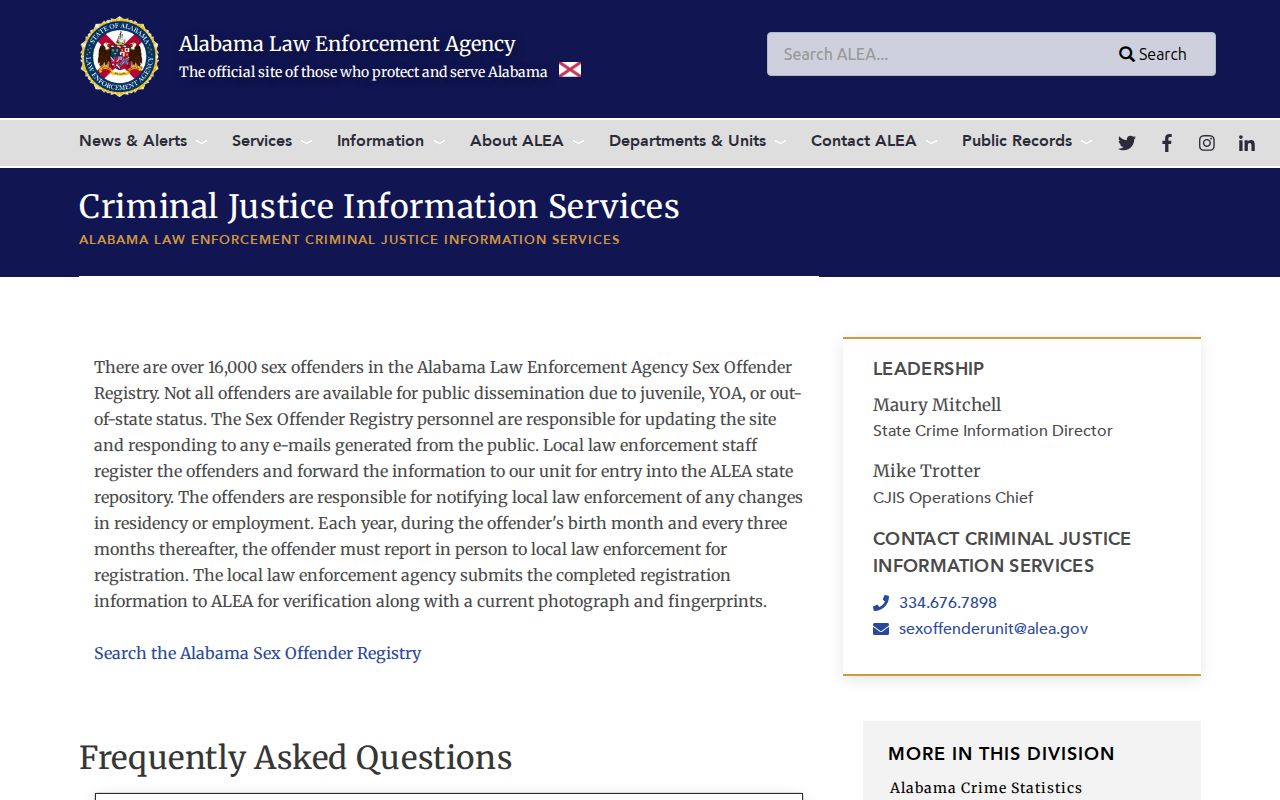
Use that registry source only for qualifying registry records. It is not a substitute for a release date, jail-book entry, or court disposition.
Registry Records and Contact
The registry source depends on the question. ALEA is the state registry owner. Mobile County OffenderWatch is the local search path identified from the sheriff source inventory. For the underlying criminal case, use court records. For the custody release record, use MCSO, ADOC, BOP, or ICE based on custody type.
Alabama Law Enforcement Agency Registry
State sex-offender registry information
ALEA registry page
Public dissemination limits apply
Mobile County OffenderWatch
Mobile County Sheriff's Office registry search path
OffenderWatch search
Applies only to published registrants
About Mobile Registry Records
The registry page belongs in the facility map because some released people have ongoing public registry duties. It should not be written as a jail page. Registry records are public safety records for a defined class of registrants, and Alabama public-dissemination rules control what appears. The record can persist after release, but it does not prove every custody detail.
Registry photographs and status fields can be useful when the person is a registrant. For non-registry releases, they are irrelevant. A released person from Metro Jail, ADOC, BOP, or ICE may have no registry record at all. Conversely, a registry listing may exist even when the underlying custody release date must be verified from another agency.
Registry Is Not Release
Research Section 16 and Section 19 warn against treating registry photos or booking photos as a complete released-inmate source. The official channels for a photo or release may be the MCSO roster while visible, MCSO records request, ADOC offender photo, registry photo for a qualifying registrant, or official news release. Those channels answer different questions.
A registry record may show location or registration data after custody. It does not tell whether a person bonded out yesterday, completed a county sentence, or transferred to ADOC unless the underlying records support that history. For custody dates, use custody records.
Restricted Registry Records
ALEA says not all offenders are available for public dissemination. Youthful Offender, juvenile, and out-of-state status can limit public availability. Expungement or sealed-record questions also belong with courts and official legal processes, not with old registry screenshots or third-party copies.
- Registrant
- A person subject to sex-offender registration and public dissemination rules where applicable.
- Public dissemination
- The legal ability to publish certain registry information to the public.
- Expungement
- A court-controlled Alabama process that can restrict access to certain criminal records when legally granted.
Note: Use the registry only for registry questions; use the record owner for custody release dates.
Registry Photo Limits
A registry photograph can help identify a published registrant, but it is not the same as a booking-photo archive. Research Section 16 separates the photo channels: MCSO roster or 24-hour booking while visible, MCSO records request after the web entry drops, ADOC photo for state custody, registry photo for qualifying registrants, and official news or press material where a public agency released a photo. Those channels should not be collapsed into one source.
If a person appears in OffenderWatch or ALEA, use that listing for registry status and public dissemination details. Use the court record for conviction and sentence context. Use MCSO, ADOC, BOP, or ICE for release or discharge dates. A registry page may update on a different schedule than a jail roster or court docket, so the most recent visible registry entry should still be checked against the record owner for custody questions.
Wrong Source Checks
A missing registry result should not be treated as a missing release record. The person may not be a registrant, may be covered by a restriction, may be listed under different identifiers, or may have a custody history that has nothing to do with registry law. Start with the custody path first, then use registry sources only when the case facts support it.
That order keeps the Mobile County record trail clean. Jail releases come from MCSO and court records. State releases come from ADOC and ABPP. Federal releases come from BOP and federal court. ICE custody comes from ODLS. Registry records are a separate public registry layer for qualifying cases.
Public Record Search
Sponsored Results