
Mobile County Federal Releases
The federal custody path serving Mobile County is not a county jail release system. Research Section 8 notes that the U.S. District Court for the Southern District of Alabama sits in Mobile and that the U.S. Marshals Service has a Southern District of Alabama office serving the area. A federal defendant may be held locally before transfer, but a sentenced federal release is confirmed through federal systems, not through MCSO after the person leaves local custody.
BOP says its Inmate Locator includes federal inmate records from 1982 forward. Its about-records page states that "Released" means the person is no longer in BOP custody and that records are extracted from the main BOP inmate database. BOP also warns that release dates may change because sentences are reviewed and recalculated. That warning is important in Mobile County because a federal case can intersect with local booking records without staying in the county record system.
| Federal stage | Best release source | Limit |
|---|---|---|
| Federal pretrial | Federal court docket and USMS | BOP may not have a sentenced-prison record |
| Sentenced BOP custody | BOP Inmate Locator | Dates can be recalculated |
| Local hold for federal matter | MCSO record plus federal docket | Roster drop may be transfer |
| Post-release supervision | Federal court/probation record | Different from Alabama parole or probation |
Confirm a Federal Release
Use the federal confirmation stack when the case is federal. If a person was only booked at Mobile County Metro Jail on a local charge, BOP will not answer that release question. If the person was sentenced federally, BOP becomes the primary public locator.
- Search the BOP Inmate Locator by register number or name for sentenced federal custody.
- Read the status carefully. BOP released or not-in-custody language means the person is no longer in BOP custody, not that all court obligations ended.
- Use the Southern District of Alabama docket or courthouse access for federal case events, bond, sentence, and supervision terms.
- Use U.S. Marshals contact for many pretrial custody questions where no BOP prison record exists.
- Return to MCSO records only for the local booking or transfer-out entry.
BOP's about-records page is the best source for interpreting federal status language. The BOP federal inmate records explanation describes released and not-in-custody terminology, and the screenshot below matches that source.
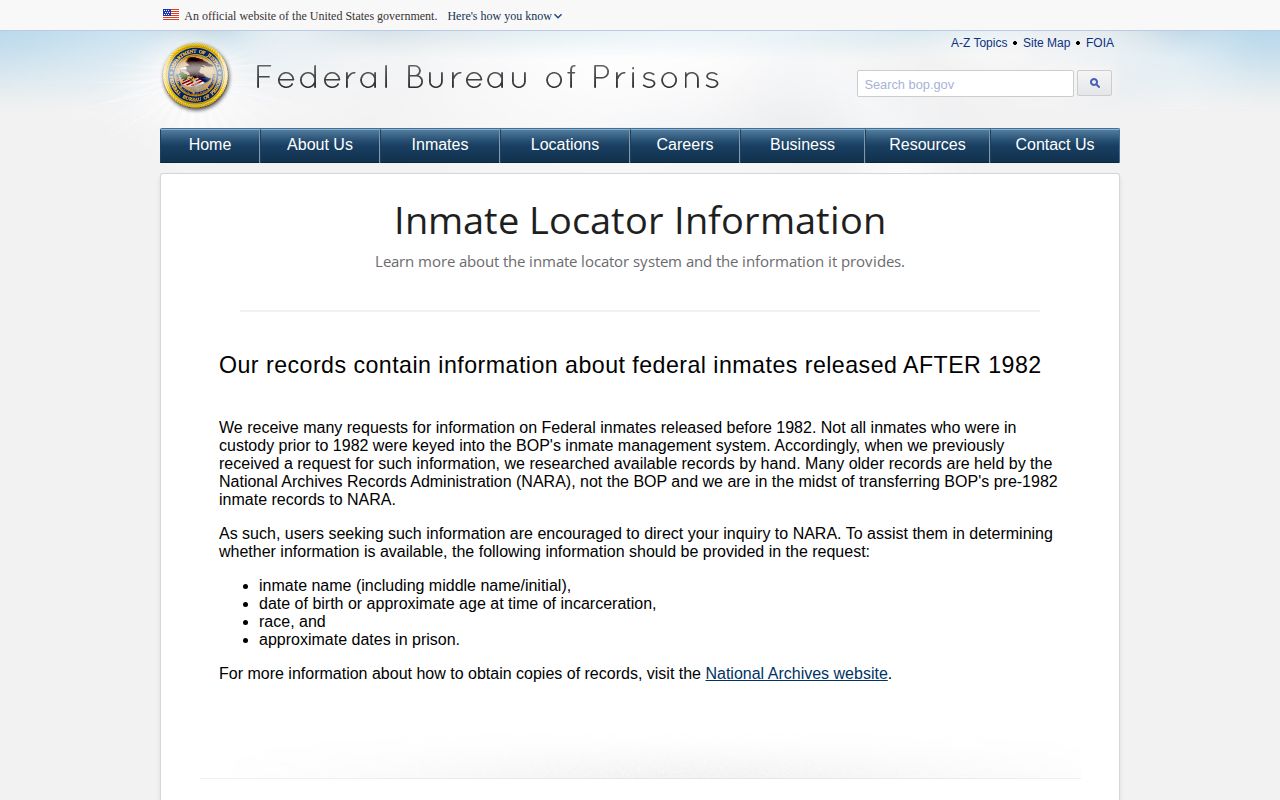
Use that federal source only for federal custody. It does not confirm a Mobile County misdemeanor bond release, a municipal case release, or an ADOC state-prison discharge.
Federal Records and Contact
The Mobile federal courthouse and USMS office are the local federal contacts identified in the research. The courthouse page lists public terminal hours, which matters when a docket cannot be checked through a simple public web summary. BOP is the release locator for sentenced federal custody, while USMS and the court are stronger for pretrial detention and transfer questions.
U.S. District Court, Southern District of Alabama
155 Saint Joseph Street
Mobile, AL 36602
251-690-2371
Public terminal hours: 9:00 a.m. to 4:00 p.m. Monday-Friday except federal holidays
U.S. Marshals Service, Southern District of Alabama
Mobile District Headquarters
251-499-6620
Federal custody and transport contact path
About Mobile Federal Custody
Mobile County's federal path includes the federal court, U.S. Marshals Service, and BOP. It is not a single jail building in the facility map because federal custody may start with local holding, proceed through court and USMS transport, and later move to a BOP institution if the person is sentenced. The release record depends on where the person is in that sequence.
A federal supervised release term is also different from Alabama parole or probation. BOP may show release from prison while the federal court sentence still includes supervised release. The court docket and federal probation context explain those terms. Avoid using county jail release language for a federal release unless the only record being described is the local hold ending.
Local Hold or Federal Transfer
Research Section 19 flags a transfer caveat: older MCSO materials described Metro Jail as holding federal pretrial or federal-sentence inmates and state inmates awaiting transfer. If someone disappears from the Mobile County jail roster, federal transfer can be one explanation. The correct description is not automatically release to the community. It may be a handoff from local custody to USMS or another federal process.
Pair MCSO and federal records when the person began in local custody. The jail-book entry may show a transfer or release from local custody. The federal docket and USMS/BOP records then show whether federal custody continued and when it ended.
BOP Locator Limits
BOP records are powerful but narrow. They cover federal inmates from 1982 forward and can show released status for BOP custody. They do not show every federal pretrial detainee held by USMS, every local jail hold, every immigration custody event, or every Alabama state prisoner. If the BOP search fails, check whether the person was ever sentenced to BOP custody.
Note: A BOP released status ends the BOP custody question; it does not answer unrelated state, local, immigration, or court-supervision questions.
Federal Docket Release Clues
The federal docket can explain events that the BOP locator cannot. Pretrial release, detention orders, bond conditions, sentencing, judgment, revocation, surrender date, and supervised release terms are court events. BOP becomes central only after a sentenced federal custody record exists. Before that stage, the Southern District of Alabama docket and USMS path are often more useful for Mobile cases.
If MCSO records show a federal handoff, pair the local transfer entry with the federal docket. The local record explains when Mobile County custody ended. The federal record explains whether custody continued, whether the person was released pending trial, whether a sentence was imposed, and whether BOP later received the person. That layered reading prevents a county roster disappearance from being mislabeled as a community release.
Public Record Search
Sponsored Results